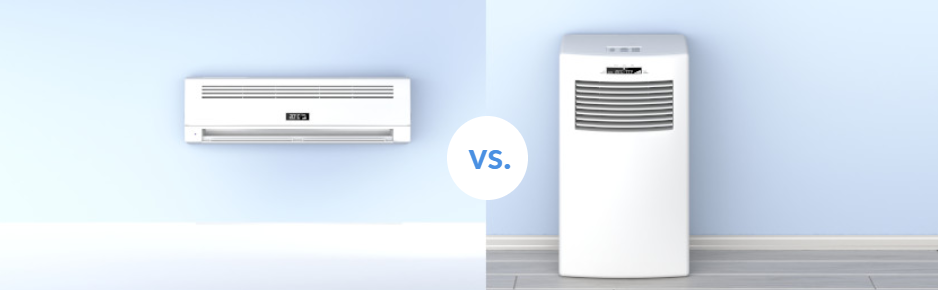
Split vs portable air conditioner Kenya is an important comparison if you are trying to cool a bedroom, apartment, office, living room or rented house without spending unnecessarily on installation and electricity. Split, portable and floor-standing air conditioners can all provide effective cooling, but they are designed for very different spaces and lifestyles.
The biggest mistake is choosing an air conditioner simply because it looks powerful or has an attractive price. Your room size, insulation, sunlight exposure, ceiling height, number of occupants, installation restrictions and how long you expect to stay in the property can all affect which AC makes sense.
A split air conditioner is usually the more permanent option. It consists of an indoor unit and an outdoor condenser connected through refrigerant piping and electrical connections. Split systems are widely used in bedrooms, living rooms, offices and other fixed spaces in Kenya.
A portable air conditioner is designed for flexibility. It normally sits on wheels and can be moved between suitable rooms, although it still needs a way to exhaust hot air, usually through a window kit.
A floor-standing air conditioner is a larger floor-mounted system designed to provide strong airflow and cooling capacity. These units can be useful for large living rooms, offices, showrooms, restaurants, halls and other spaces where a wall-mounted unit may not be sufficient.
So, when considering split vs portable air conditioner Kenya, the right question is not simply which type is best. It is which type best fits your space, budget and lifestyle.
What Is the Difference Between Split, Portable and Floor Standing ACs?
Split ACs are permanent systems with separate indoor and outdoor units, portable ACs are movable units designed for flexibility, and floor-standing ACs are larger floor-mounted systems designed for powerful cooling. Each type solves a different cooling problem.
The three systems work on the same basic refrigeration principle: heat is removed from indoor air and rejected elsewhere. Their physical design and installation requirements are what make them different.
A split system has an indoor evaporator unit and an outdoor condenser unit. The two are connected by refrigerant pipes, drainage and electrical connections.
This separation is one reason split systems can operate relatively quietly indoors. The compressor and condenser components are located outside.
Portable air conditioners combine most of the cooling system into a single mobile cabinet. You place the unit inside the room and connect an exhaust hose to an appropriate opening.
The main attraction is flexibility.
If you are renting a property in Nairobi and do not want permanent modifications, a portable unit may appear attractive. However, portable does not mean completely installation-free. You still need appropriate ventilation for the hot exhaust air.
Floor-standing ACs can also be split systems, meaning the indoor cabinet stands on the floor while the outdoor condenser is installed separately.
They are generally aimed at spaces requiring stronger airflow and greater cooling capacity than many residential wall-mounted units.
Current Kenyan suppliers position floor-standing systems for applications such as large rooms, halls, reception areas, restaurants, showrooms and offices.
Split vs Portable Air Conditioner Kenya: Which Is Better for a Rented House?
For a rented house, a portable AC can be the simplest option when permanent installation is restricted. A split AC may still be the better long-term solution if the landlord allows installation and you expect to stay in the property for several years.
Renting changes the buying decision.
If you live in a rental apartment, you may not be allowed to drill walls, install brackets or mount an outdoor condenser.
In that situation, a portable air conditioner can offer greater flexibility.
You can move it when you move house.
However, there are practical limitations.
A portable AC needs to expel the heat it removes from the room. This usually requires an exhaust hose connected to a window or another suitable opening.
If the room has unsuitable windows, poor sealing or no convenient exhaust route, the portable unit may not perform as expected.
Before buying one for a rented house, check:
- Whether the landlord allows window exhaust equipment
- Whether the window can accommodate the exhaust kit
- Whether the room has a suitable power outlet
- Whether drainage or condensate management is required
- Whether the unit can be stored and moved easily
- Whether noise is acceptable at night
If your landlord permits professional installation and you expect to remain in the property for a long period, a split system may provide better everyday comfort.
For renters who move frequently, however, portability can outweigh those advantages.
Which AC Is Better for a Bedroom in Kenya?
A properly sized split AC is often the strongest choice for a bedroom because it can provide quiet, consistent cooling without placing the compressor inside the room. A portable unit can work where permanent installation is not practical.
Bedrooms have different requirements from shops or large offices.
Noise is particularly important because an air conditioner may operate while you sleep.
A split system places the outdoor condenser away from the sleeping area, which can help reduce indoor noise compared with designs that keep most mechanical components inside.
You should also consider airflow.
An AC should cool the room without creating an uncomfortable blast of cold air directly onto the bed.
The indoor unit should therefore be positioned carefully.
A portable AC can be useful for a bedroom in a rental apartment, particularly when installation restrictions prevent a split system.
But check the noise rating before purchasing.
A machine that seems acceptable during the day may become distracting at night.
For a permanent bedroom installation, an appropriately sized inverter split AC is often a strong option.
Split vs Portable Air Conditioner Kenya: Which Uses Less Electricity?
Electricity consumption depends on the specific model, cooling capacity, efficiency and operating conditions, but modern inverter split systems are generally attractive for households that run AC for many hours. Portable ACs can make sense when installation flexibility is more important than maximum efficiency.
An air conditioner can become a significant electrical load if operated for long periods.
That makes efficiency an important part of the buying decision.
When comparing split vs portable air conditioner Kenya, look beyond the advertised cooling capacity.
Check:
- Energy-efficiency information
- Inverter or fixed-speed operation
- Rated power input
- Cooling capacity
- Operating modes
- Intended room size
- Warranty
- Maintenance requirements
Inverter technology allows the compressor to adjust its operating speed rather than simply switching fully on and off.
This can be useful when an AC runs for extended periods.
However, do not assume that every inverter AC will automatically use less electricity than every non-inverter model. Actual consumption depends on the equipment and operating conditions.
Your room also matters.
An undersized machine may need to run continuously without adequately cooling the space.
An oversized machine may cycle differently and may not provide ideal humidity control.
Proper sizing is therefore more important than simply buying the largest AC you can afford.
Which AC Is Quieter: Split, Portable or Floor Standing?
Split systems generally have an advantage when low indoor noise is a priority because the compressor and condenser are located outdoors. Portable units keep more operating components inside the room, while floor-standing systems vary by model and design.
Noise matters particularly in:
- Bedrooms
- Study rooms
- Home offices
- Consultation rooms
- Hotel rooms
- Small offices
With a split AC, the indoor unit mainly circulates and conditions air while the outdoor unit houses the compressor and condenser.
Portable units have their mechanical equipment in the indoor cabinet.
That means you hear the machine operating in the room.
Floor-standing systems can vary considerably.
Before buying, check the manufacturer’s indoor sound-level specifications where available.
Do not rely only on the phrase “quiet.”
A specific decibel rating is more useful when comparing two models.
Also remember that installation affects noise.
A poorly mounted outdoor condenser can transmit vibration through a wall or bracket.
An improperly levelled floor-standing unit can also create unwanted vibration.
Professional installation therefore matters.
Floor Standing AC Kenya: When Does It Make Sense?
A floor standing AC makes the most sense when you need strong airflow and cooling for a larger space or when a conventional wall-mounted unit is not suitable. It is generally better suited to large living rooms, offices, restaurants, showrooms and other high-use spaces than small bedrooms.
A floor standing AC Kenya buyer should start with the room rather than the machine.
Floor-standing systems are available in substantially larger capacities than many small residential units.
Kenyan suppliers currently list floor-standing systems ranging from medium capacities to much larger units designed for halls and commercial environments.
Potential applications include:
- Large living rooms
- Open-plan offices
- Restaurants
- Hotel spaces
- Showrooms
- Reception areas
- Conference rooms
- Places of worship
- Commercial halls
The main advantage is powerful air delivery.
A large space may require substantially more cooling capacity than a typical bedroom.
However, capacity should be selected based on the actual cooling load.
Room dimensions alone are not enough.
Sun exposure, windows, ceiling height, insulation, occupancy and heat-producing equipment can all affect cooling requirements.
Is a Floor Standing AC Better Than a Split AC?
A floor-standing AC is not automatically better than a wall-mounted split AC; it is simply designed for different applications. For a normal bedroom or modest living room, a properly sized split can be more practical, while larger spaces may benefit from floor-standing equipment.
The comparison should be based on application.
For a bedroom, a large floor-standing unit may be unnecessary.
For a spacious restaurant, a small bedroom-sized split may be inadequate.
Floor-standing units can also create strong airflow at lower levels, which may be useful in large open spaces.
A split system, on the other hand, usually distributes conditioned air from a higher wall position.
The decision therefore depends on:
- Room size
- Ceiling height
- Layout
- Occupancy
- Heat gain
- Desired airflow
- Installation possibilities
- Budget
- Operating hours
If you are unsure, have the room assessed before selecting the capacity.
Split vs Portable Air Conditioner Kenya: Installation Comparison
Portable ACs usually have the simplest setup, while split and floor-standing split systems require professional installation involving refrigerant lines, drainage, electrical connections and outdoor-unit placement. Installation should be treated as part of the purchase rather than an afterthought.
Installation is one of the biggest differences between these systems.
A portable unit can normally be positioned inside the room and connected to an appropriate window exhaust arrangement.
A split system requires considerably more work.
The installer needs to determine:
- Indoor unit position
- Outdoor condenser location
- Refrigerant pipe route
- Drainage route
- Electrical connection
- Wall mounting requirements
- Outdoor support
- Commissioning
Installation cost can vary substantially depending on piping length, building type, electrical work, drainage and access.
This means comparing the price of the AC unit alone can be misleading.
A cheaper split AC may become more expensive after installation if the site requires extensive pipework or electrical modifications.
A portable unit may have a higher operating cost but a much lower installation barrier.
The total cost should therefore include both purchase and installation.
Which AC Is Best for an Apartment?
For an apartment, choose a split AC when permanent installation is permitted and you want efficient long-term cooling. Choose portable cooling when you need flexibility or cannot make permanent alterations to the property.
Apartments create several practical challenges.
You may have restrictions on:
- External walls
- Balcony installations
- Drilling
- Outdoor condensers
- Drainage
- Building appearance
- Electrical modifications
Before purchasing a split system, ask your landlord or building management about installation permissions.
In some apartment buildings, there may already be designated locations for outdoor AC condensers.
If those locations exist, installation becomes much easier.
For renters, portability can be valuable.
But portable ACs still need proper heat exhaust.
A portable unit should not simply be operated with hot exhaust air released back into the room.
That would undermine the cooling process.
Which AC Is Best for a Large Living Room?
A large living room may require a higher-capacity split or floor-standing AC depending on its size and cooling load. Floor-standing systems become particularly attractive when the room is large, open-plan or heavily occupied.
Large living rooms often have more heat gain.
Factors include:
- Large windows
- Direct afternoon sunlight
- High ceilings
- Open-plan layouts
- Several occupants
- Televisions and electronics
- Kitchens connected to living spaces
- Poor insulation
Do not choose a capacity simply because someone says a particular BTU rating works for every room of a certain size.
Cooling requirements vary.
A professional assessment can help determine the appropriate capacity.
If the living room is very large or opens into other areas, a floor-standing system may be worth considering.
If it is a conventional enclosed living room, a properly sized split AC may provide the right balance between cooling, installation and appearance.
Which AC Is Best for an Office?
Split ACs are often practical for individual offices and smaller workspaces, while floor-standing systems can suit large open-plan offices or high-occupancy areas. Portable units can be useful for temporary offices or rented spaces where permanent installation is difficult.
Office cooling has different priorities from residential cooling.
Noise matters because employees need to concentrate.
Air distribution matters because one person should not receive excessive cold air while another area remains warm.
Operating hours also matter.
An office running AC for eight or more hours a day can benefit significantly from an efficient system.
For a small private office, a wall-mounted split may be sufficient.
For an open-plan office, several appropriately positioned systems may be more effective than one oversized unit.
For larger commercial areas, floor-standing systems or a more advanced HVAC solution may be appropriate.
How Important Is Inverter Technology?
Inverter technology can be valuable for ACs that operate for long periods because the compressor can adjust its speed to match cooling demand. However, efficiency still depends on correct sizing, installation, maintenance and the specific model.
An inverter compressor does not simply operate at one fixed speed.
It can adjust its output according to the cooling requirement.
Once the room approaches the desired temperature, the system can reduce output rather than repeatedly operating at full capacity.
This can improve comfort and potentially reduce energy consumption.
In Kenya, this can be especially relevant for households and businesses that operate AC for several hours each day.
However, an inverter is not a substitute for correct sizing.
A poorly selected AC can still perform badly even if it uses inverter technology.
Installation quality also matters.
Poor refrigerant installation, inadequate airflow, dirty filters or incorrect electrical connections can all affect performance.
Split vs Portable Air Conditioner Kenya: What About Maintenance?
All three AC types require maintenance, but the tasks differ. Split systems need filter cleaning, indoor and outdoor-unit maintenance and professional servicing, while portable units require attention to filters, exhaust arrangements and condensate management.
Regular maintenance helps preserve cooling performance.
For split systems, maintenance may include:
- Cleaning air filters
- Cleaning the indoor coil
- Cleaning the outdoor condenser
- Checking refrigerant-related issues
- Inspecting drainage
- Checking electrical connections
- Inspecting outdoor-unit condition
Portable systems also require regular filter cleaning.
Depending on the model, condensate may need to be drained or managed through the unit’s drainage system.
The exhaust hose and window connection should also be checked.
Floor-standing systems require similar attention to filters, coils, drainage and outdoor components where applicable.
Do not wait until an AC stops cooling before servicing it.
Reduced airflow, unusual smells, unusual noise or water leakage can be signs that maintenance is needed.
Which AC Is More Rental-Friendly?
Portable ACs are generally the most rental-friendly because they require fewer permanent modifications. A split system can still work in a rental if the landlord permits installation and the installation can be reversed or transferred appropriately.
If you expect to move within a year or two, portability may be particularly valuable.
You can potentially take the machine with you.
A split AC becomes part of the property once installed unless it is professionally removed.
Removing and reinstalling a split system also involves labour and technical work.
Therefore, consider how long you expect to remain in the property.
A renter staying for many years may still find that a professionally installed split AC provides better everyday comfort.
A renter who moves frequently may prefer the flexibility of a portable system.
Split vs Portable Air Conditioner Kenya: Which Is More Attractive for Nairobi?
Nairobi buyers should consider both cooling requirements and property type because apartments, offices, standalone homes and rental properties have different installation constraints. For many permanent residential installations, split systems offer a strong balance of comfort, noise and efficiency, while portable ACs provide flexibility.
Nairobi’s climate is different from Kenya’s coastal regions.
A buyer in Nairobi may have different cooling requirements from someone in Mombasa, Malindi or another hot coastal location.
That does not mean air conditioning is unnecessary in Nairobi.
Rooms with large windows, direct sunlight, poor ventilation, high occupancy or heat-generating equipment can become uncomfortable.
The building itself therefore matters.
For a Nairobi apartment bedroom, a properly sized split inverter AC can be an attractive permanent solution.
For a rented apartment where drilling is restricted, a portable AC may be more practical.
For a large office, showroom or commercial room, floor-standing equipment may provide the airflow and capacity required.
Split vs Portable vs Floor Standing AC: Side-by-Side Comparison
Split ACs are strongest for permanent residential and office cooling, portable ACs are strongest for flexibility, and floor-standing ACs are strongest when larger spaces need powerful airflow. The best option depends on the space rather than the AC category alone.
| Feature | Split AC | Portable AC | Floor Standing AC |
|---|---|---|---|
| Installation | Professional installation required | Minimal setup, but exhaust required | Professional installation for split-type systems |
| Mobility | Low | High | Low |
| Rental suitability | Moderate | Excellent | Low to moderate |
| Indoor noise | Generally low | Generally higher | Varies by model |
| Cooling capacity | Small to large | Usually smaller residential applications | Medium to very large |
| Space requirement | Wall + outdoor space | Floor space | Floor space + outdoor system where applicable |
| Appearance | Compact wall unit | Visible cabinet and hose | Large cabinet |
| Long-term use | Excellent | Good for flexible use | Excellent for large spaces |
| Best for bedrooms | Excellent | Good | Usually unnecessary |
| Best for large rooms | Good to excellent | Limited by model | Excellent |
| Best for offices | Excellent | Temporary/small offices | Large offices |
| Installation flexibility | Lower | Highest | Moderate |
| Upfront installation complexity | Higher | Lower | Higher |
| Portability | No | Yes | No |
Individual models differ, so this comparison should be used as a buying framework rather than a substitute for the specifications of a particular AC.
Which AC Should You Buy in Kenya?
Choose a split AC for permanent, quiet and efficient cooling; choose a portable AC for rental-friendly flexibility; and choose a floor-standing AC when a larger space needs stronger cooling and airflow. The right capacity is just as important as the type of AC.
A split vs portable air conditioner Kenya decision becomes easier when you start with your circumstances.
Choose a split AC if:
- You own the property.
- Your landlord permits permanent installation.
- You want quiet bedroom cooling.
- You expect to stay for several years.
- You want a clean wall-mounted appearance.
- You operate the AC for long periods.
- You can accommodate an outdoor condenser.
Choose a portable AC if:
- You rent.
- You move frequently.
- Permanent installation is restricted.
- You need cooling in one room.
- You want to move the AC between suitable spaces.
- You need a temporary cooling solution.
Choose a floor-standing AC if:
- You have a large living room.
- You operate a showroom.
- You have a large office.
- You manage a restaurant.
- You need strong airflow.
- A wall-mounted system is unsuitable.
- You need cooling for a larger commercial space.
What Should You Check Before Buying an Air Conditioner?
Do not buy an AC based only on price or BTU. Check the room’s cooling requirements, installation conditions, energy efficiency, noise, warranty, maintenance requirements and the availability of qualified service support.
Before paying for an air conditioner, check:
Cooling capacity
Make sure the capacity is appropriate for the space.
A larger number is not automatically better.
Energy efficiency
Look for efficiency information and consider inverter technology if the AC will operate for long periods.
Installation
Ask what installation includes.
Confirm whether the quotation covers:
- Copper piping
- Electrical work
- Drainage
- Brackets or supports
- Outdoor-unit installation
- Commissioning
Installation requirements can vary significantly between buildings.
Warranty
Confirm:
- Warranty period
- What is covered
- Who handles repairs
- Whether installation affects warranty coverage
Spare parts
Ask whether replacement filters, remotes, electronic components and other service parts are readily available.
Noise
If the AC will be installed in a bedroom or office, check the indoor noise specification.
Maintenance
Understand how often filters need cleaning and whether professional servicing is recommended.
Where to Shop for Air Conditioners in Kenya
A good AC purchase should include the right product, correct sizing and dependable installation or after-sales support. Compare the actual specifications and total installation requirements rather than choosing solely by advertised price.
If you are upgrading your home, air conditioning can also be considered alongside other household appliances.
For example, you can compare available:
When comparing air conditioners, make sure you establish the required cooling capacity before selecting the final model.
Frequently Asked Questions
Is a split AC better than a portable AC in Kenya?
For permanent installations, a properly sized split AC is often the stronger choice for quiet, consistent cooling. A portable AC is more attractive when flexibility and easy relocation are the priority.
What is the best AC for a rented house in Nairobi?
A portable AC can be the most convenient option when permanent installation is not permitted. If your landlord allows installation and you expect to stay long-term, a split inverter AC may provide better everyday comfort.
Is a portable AC good for a bedroom?
Yes, a portable AC can cool a bedroom, particularly in a rental property. However, check its noise level and ensure the hot-air exhaust can be properly vented outside.
Is a floor standing AC good for a large living room?
Yes. Floor-standing systems can be suitable for large living rooms because they can provide strong airflow and are available in higher cooling capacities. The exact capacity should be selected based on the room’s cooling load.
Which AC is cheapest to install?
Portable ACs generally have the lowest installation requirements because they do not require the same refrigerant piping and outdoor-unit installation as split systems. However, they still require appropriate hot-air exhaust.
Which AC uses less electricity?
There is no universal answer because consumption depends on the model, capacity, efficiency and usage. Efficient inverter split systems can be attractive for long operating hours, but actual specifications should be compared.
Does a portable AC need a window?
Most portable air conditioners require a method of exhausting hot air outside the room, commonly through a window kit. Check the manufacturer’s installation requirements for the specific model.
Is floor standing AC better than wall mounted?
Not necessarily. Wall-mounted split ACs are often better suited to bedrooms and ordinary living spaces, while floor-standing systems can be more appropriate for larger spaces requiring stronger airflow and higher capacity.
How many BTUs do I need for my room?
There is no single BTU figure that applies to every room of a particular size. Room dimensions, ceiling height, sunlight, windows, insulation, occupancy and heat-producing equipment can all affect the required capacity.
Should I buy an inverter AC in Kenya?
An inverter AC can be a good choice if you expect to operate the system frequently or for long periods. Compare the inverter’s efficiency, capacity, warranty and purchase price against the specific non-inverter alternatives available.
Final Verdict: Split, Portable or Floor Standing?
For most permanent bedrooms and ordinary residential spaces, a properly sized split AC is a strong all-round choice. Portable ACs win on flexibility for renters and temporary spaces, while floor-standing systems make more sense for large rooms and commercial environments requiring powerful airflow.
The best choice in the split vs portable air conditioner Kenya comparison depends on your property and how you intend to use the machine.
If you own your home and want long-term cooling, start by considering a split inverter system.
If you rent and cannot make permanent alterations, a portable AC can give you greater freedom.
If you have a large living room, office, restaurant, showroom or hall, investigate floor-standing systems and have the required capacity assessed properly.
Do not overlook installation.
A high-quality AC can perform poorly if it is badly positioned, incorrectly sized or improperly installed.
Similarly, an inexpensive portable unit may become frustrating if the exhaust cannot be routed outside properly.
The smartest approach is to evaluate the entire system:
Space + cooling requirement + installation + electricity consumption + noise + maintenance + warranty + length of stay.
That gives you a more realistic answer than asking which AC type is universally the best.
Al Mansoor Smart Home Appliances
Location: Our Mall, Off Magadi Road, Nairobi, Kenya
Phone: +254 114 696 921
Email: amvsmarthomeappliances@gmail.com